

Can we still engage in honest conversation?
The beginning of September marked the first week of my final semester in college. I was finding my way to the cafeteria between classes when my phone started blowing up. Members of a Discord server I’m part of informed me that there was a group of far-right extremists on campus harassing students and filming them without consent to edit together some Charlie Kirk-esque propaganda deceptively. Members of the Discord server warned one another not to engage and attempted to find ways to get the entire group of extremists kicked off campus. I like to do a little bit of trolling sometimes. I was wearing a fairly provocative T-shirt and had nothing better to do. I decided to find these extremists and mess with them a bit.
After a brief search, I found them. I say “them,” but what I actually mean is “him.” Instead of a group of people, it was a single man with a microphone. Instead of filming without consent, he only engaged with students who volunteered to step into a ring. Nearby was a semi-provocative sign asking, “Convince me why I should be woke.” I was somewhat disappointed that I wouldn’t get a chance to mess with a group of people, but I decided to step into the ring anyway.
Instead of extremist nonsense, he was asking people questions like “Why do you believe abortion is right/wrong? Are there any exceptions to your position?” He wasn’t an extremist at all. He was asking people to reflect critically on their beliefs, which is something we should all be doing anyway. We had a short but productive conversation before I had to leave for my next class.
Here is the problem: A community on campus assumed that someone had ill intentions and would criticize their identity, and then proceeded to act as if that assumption was valid, without engaging with the person a single time. On one level, that is understandable. People in that Discord server are overwhelmingly queer, and the Trump administration has worked overtime to discriminate against LGBT folks.
But on another level, this is indicative of a much deeper problem. We’ve become so accustomed to our own echo chambers that we assume anyone who challenges our beliefs is acting in bad faith. We’re so terrified of different perspectives that we refuse even to hear what they are. When we only hear our own side of the story, we lose nuance and think the world is black and white, when in fact, everything is actually shades of grey.
Bad actors who engage in dishonest discourse are the root cause of this problem, but we all need to work together to overcome it. Please, listen to people you disagree with. You don’t need to change your mind; you need to examine your own beliefs. When beliefs remain completely unchallenged, they progressively get farther from the truth. Every time your beliefs are challenged and you engage in critical reflection, you develop a slightly better understanding of our world.
It’s also why I write this. I don’t think I have any of the answers. In fact, I really don’t like it when people unequivocally agree with me. All I want to do is make someone think, just a little bit. Leave me a comment telling me everything I got wrong. Let’s talk about it, and hopefully, we can both learn something.
Featured image from Wikimedia.

Like what you see?
This article was originally published to James' Substack, Sarcastrophe. Consider taking a look at other published works.
Written by
What's Next?


Gun Violence
What are the root causes? I’ve thought about this topic for a long time, and the recent tragic Minneapolis shooting made me decide it’s time to write about it. Despite having only about 5% of the world’s population, America features somewhere around 30% of global mass shootings, even managing to eclipse notoriously dangerous countries like Colombia and Uganda. For transparency, this statistic only includes lone-wolf single actors and does not count terrorism or gang warfare. A common theme of
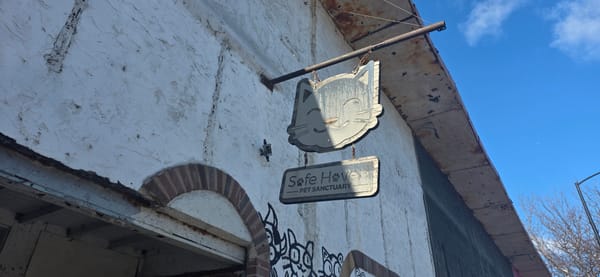
City of Green Bay Orders Removal of Unhoused
Today, Safe Haven Pet Sanctuary received an order from the City of Green Bay to stop housing unhoused people overnight. This comes after Safe Haven allowed unhoused people to stay during the snap freeze, with many people unable to access alternatives like St. John’s Homeless Shelter. The order also listed allegations of drinking and smoking occurring on the premises. These claims are currently unsubstantiated. Instead of working to house these people, the city is focusing on attacking businesses